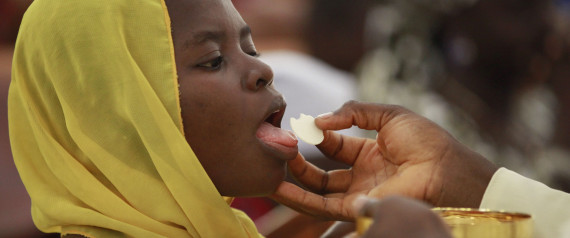
BREAD OF LIFE

BREAD OF LIFE
 this is the bread that comes down from heaven so that one may eat it and not die. (john 6: 50)
Thursday, September 20, 2007 "O Blessed Host, in whom is contained the testament of God’s mercy for us" Folks, in this day and age when most people don't give a hoot about the Lord, and still others insult Him in a myriad ways, and even more dare to attack His Real Presence in the Blessed Sacrament, we'll do well to remember and pray these words recorded in the Diary of St. Faustina Kowalska (the Apostle of the Divine Mercy): O Blessed Host, in whom is contained the testament of God’s mercy for us, and especially for poor sinners. O Blessed Host, in whom is contained the Body and Blood of the Lord Jesus as proof of infinite mercy for us, and especially to poor sinners. O Blessed Host, in whom is contained life eternal and of infinite mercy, dispensed in abundance to us and especially to poor sinners. O Blessed Host, in whom is contained the mercy of the Father, the Son and the Holy Spirit toward us, and especially toward poor sinners. O Blessed Host, in whom is contained the infinite price of mercy which will compensate for all our debts, and especially those of poor sinners. O Blessed Host, in whom is contained the fountain of living water which springs from infinite mercy for us, and especially for poor sinners. O Blessed Host, in whom is contained the fire of purest love which blazes forth from the bosom of the Eternal Father, as from an abyss of infinite mercy for us, and especially for poor sinners. O Blessed Host, in whom is contained the medicine for all our infirmities, flowing from infinite mercy, as from a fount, for us and especially for poor sinners. O Blessed Host, in whom is contained the union between God and us through His infinite mercy for us, and especially for poor sinners. O Blessed Host, in whom are contained all the sentiments of the most sweet Heart of Jesus toward us, and especially poor sinners. O Blessed Host, our only hope in all the sufferings and adversities of life. O Blessed Host, our only hope in the midst of darkness and of storms within and without. O Blessed Host, our only hope in life and at the hour of our death. O Blessed Host, our only hope in the midst of adversities and floods of despair. O Blessed Host, our only hope in the midst of falsehood and treason. O Blessed Host, our only hope in the midst of the darkness and godlessness which inundate the earth. O Blessed Host, our only hope in the longing and pain in which no one will understand us. O Blessed Host, our only hope in the toil and monotony of everyday life. O Blessed Host, our only hope amid the ruin of our hopes and endeavors. O Blessed Host, our only hope in the midst of the ravages of the enemy and the efforts of hell. O Blessed Host, I trust in You when the burdens are beyond my strength and I find my efforts are fruitless. O Blessed Host, I trust in You when storms toss my heart about and my fearful spirit tends to despair. O Blessed Host, I trust in You when my heart is about to tremble and mortal sweat moistens my brow. O Blessed Host, I trust in You when everything conspires against me and black despair creeps into my soul. O Blessed Host, I trust in You when my eyes will begin to grow dim to all temporal things and, for the first time, my spirit will behold the unknown worlds. O Blessed Host, I trust in You when my tasks will be beyond my strength and adversity will become my daily lot. O Blessed Host, I trust in You when the practice of virtue will appear difficult for me and my nature will grow rebellious. O Blessed Host, I trust in You when hostile blows will be aimed against me. O Blessed Host, I trust in You when my toils and efforts will be misjudged by others. O Blessed Host, I trust in You when Your judgments will resound over me; it is then that I will trust in the sea of Your mercy.

Thursday, May 9, 2013

ONENESS, DEPRESSION & JILL BOLTE TAYLOR

The story of her stroke and remarkable recovery are now well-known, through her book, My Stroke of Insight: A Brain Scientist’s Personal Journey, through the remarkable 18-minute video of her TED talk and through multiple interviews and articles in national media. Though Jill Bolte Taylor emphasizes her professional experience as a neuroanatomist, she has become a star not of science but of a kind of humanist spirituality.

She passionately pleads for a shift of humanity toward the intuitive side of life and the dwelling in a state of peace achieved by apprehension of the union of all things through a powerful energy or life force. That is the state she came to by the impact of a stroke that stripped away all other mental functioning, including the understanding and speaking of language, as well as the command of her own body.

At one point in the TED video, she refers to the “nirvana” she reached through physical disaster. Her description of this state of oneness with things is remarkable and matches those of others who have achieved such experience through spiritual discipline, mystical encounters or an altered consciousness assisted by hallucinogenic drugs. But this is no momentary vision. It was what she had left of her mind, her awareness, her functional capacities in the aftermath of the stroke. And it is the state she says is accessible to her whenever she becomes oppressed by the tensions and depression that can be brought on by excessive dwelling in the analytic, verbal, organizing part of her mind.

I have been reading recently in the Christian mystical tradition and what strikes me is the parallel between her account of this state of oneness and classical descriptions of the union with God achieved by a human soul through “infused contemplation.”

There are three elements of the experience that help illuminate what she went through.

There were no boundaries to her body. She couldn’t feel any separation from other things as an individual physical entity. Instead, she felt part of a pure energy that filled the universe. As she said in her TED talk, she became vast in that state and couldn’t imagine being contained again within a small single body.

Though she had lost her language abilities, memories, analytical functions, and a sense of the linear direction of time, she retained awareness and seemed to apprehend what she was experiencing in a direct way, without the language-oriented consciousness that usually filters and organizes what is happening. She was immersed in the life force she felt and, in a sense, became what she perceived inwardly. There was no complicated chain of perception, interpretation by the brain of external signals and formation of an intellectual concept of what was going on. It was a kind of knowing through pure intuition and feeling.

Once she got used to this state of existence, she experienced a complete peacefulness and joy that later became a touchstone helping her to measure the quality of her inner condition. With the return of her intellectual faculties and customary consciousness, she felt separated from that pure energy state and deep peacefulness.

She associates the negative aspects of living, such as tension, anxiety or depression, with her analytical mind. Remarkably, she is able to pull back from excessive involvement with that linear, symbol-interpreting part of her mind. She can stop herself from going too far in that direction, shift more to her intuitive side and find peace again in the sense of oneness that she first experienced in the immediate aftermath of the stroke. She believes passionately that this ability can be cultivated by everyone.

Thomas Merton quotes several Christian mystical writers in his absorbing book on the experience of contemplation, The Inner Experience: Notes on Contemplation. Here are two passages trying to capture an inner state that is beyond human experience and beyond the power of language to portray.

First, the anonymous 14th century author of The Cloud of Unknowin

Through grace a man can have great knowledge of all other creatures and their works, and even of the works of God Himself, and he can think of them all; but of God Himself no man can think. I would therefore leave all those things of which I can think and choose for my love that thing of which I cannot think.

And why is this so? He may well be loved, but He may not be thought of. He may be reached and held close by means of love, but by means of thought, never. … You are to strike the thick cloud of unknowing with a sharp dart of longing love; and you are not to retreat no matter what comes to pass.

In other words, just as Taylor had to leave behind her thinking, analytical brain to reach the state of oneness with all things, this author says that thinking is not the way in which one can reach union with God. It is only by love that this is possible. Language and thought fail, but feeling and love bring what knowledge a human can have of God’s presence. And the contemplative never actually sees God – He is concealed in that cloud of unknowing. Only His presence is sensed. Watch Jill Taylor in her TED video, and you will see through her passion and tears that it is a kind of love that fills her as she recalls/relives the experience of the state of oneness with all things.

Here is another quotation cited in Merton’s book, this from a Flemish mystic of the 14th century. It goes directly to Taylor’s experience of oneness in the moment (Now) where time and distinctions among things fall away, and the connectedness of the universe is what she feels.

This purity is the dwelling place of God within us … it is eternal, and in it is neither time nor place, neither before nor after: but it is ever present, ready and manifest … In it we are all one, living in God and God in us. This simple unity is ever clear and manifest to the intellectual eyes when turned in upon the purity of the mind. It is a pure and serene air, lucent with divine light; and it is given to us to discover, fix and contemplate eternal truth with purified and illuminated eyes. Therein all things are of one form and become a single truth, a single image in the mirror of the wisdom of God: and when we look upon and practice it in the divine light with these same simple and spiritual eyes, then have we attained the contemplative life.

Given the interval of 700 years between the writings of these mystics and Jill Bolte Taylor’s description, it is remarkable to find the similarities. Though she avoids explicit references to God, the key elements of a common quality and intensity of experience come through. The sense of peacefulness and joy, the inner vision, the blending of all things into “one form” that “become a single truth,” the perception of this state with “simple and spiritual eyes,” rather than with the analytical faculties.

I believe it is less relevant to try to explain Taylor’s experience in scientific terms than simply to enter with her into the evocation of a state of universal peace and oneness. She is helping us glimpse an experience that human beings have shared across the ages. And she also dramatizes that this state of being is one in which such problems as depression fall away completely. Her insight that such disorders and tensions are linked with the analytical, planning and linguistic functions of the mind is a powerful one for all of us trying to understand the spiritual ways out of the trap of depression.

http://www.storiedmind.com/spirituality/oneness-depression-jill-bolte-taylor/

Wednesday, May 1, 2013

LOVE'S OPPOSITE: SIN

In psychological terms, sin can be described as a sort of infatuation with the vanity of our personal desires. That is, most people are narcissistically preoccupied with their immediate desires and have little, if any, altruistic awareness of anyone or anything else around them.

Psychologically, this behavior allows you to feel good about yourself (that is, to feel strong and “in control”) by using, hurting, or neglecting someone else. Sin therefore leads you away from true love and compassion, and it sends you right into all the predicaments of self-indulgence. Sin really does hurt others because sin defiles love.

 Simply teaching children to be kind to one another, therefore, will not make sin “take a back seat.” In fact, teaching kindness without also teaching the full meaning of sin unwittingly promotes sin. Without an awareness of sin, anything goes. “If it feels good, do it,” is equivalent to the devil’s motto : Do what thou wilt.

Thursday, April 18, 2013

GUARDIAN ANGEL

Good Angels, Bad Angels

If Satan can assume the form of a good angel, how do I really know when an angel is good or bad?

To explore the topic of distinguishing good angels from bad angels. The answers are found in the Bible.

How can one tell if an angel is a good or evil? "The Creator willed that there should be communication between angels and men, and as the angels are of two kinds, good and bad, the latter try to win us over to their rebellion and the former endeavor to make us their companions in obedience."

If you become aware that there may have been an angel in your life, how can you tell if it is of God or the Evil One? We are warned in 2 Corinthians 11:14, "Even Satan disguises himself as an angel of light." In the New Testament telling the difference between the good and bad angels is called the gift of discernment. (I Corinthians 12:10) Here are some practical guidelines that will help us determine if the message we are receiving is from God. "Beloved, do not believe every spirit, but test the spirits to see whether they are of God" (1 John 4:1).

Here are five ways to help you distinguish between good and bad angels:

1. God and His holy angels will never tell you anything that that contradicts what is found in the Bible (Galatians 1:8). A favorite way Satan and his angels tempt us is to persuade us to disregard God’s instructions. This pattern began in Genesis 3 when the serpent tempted Eve not to listen to God but to eat the forbidden fruit. The basic way to discern between good and evil angels is this: If it is from God, the message will always agree with the clear teachings of the Bible.

To illustrate my point, here is a story: Harold had been deeply hurt by his friend Mark. One night Harold had a very vivid dream of an angel who spoke to him, "Don’t get mad. Get even." In the dream a clever plan unfolded showing Harold a way to hurt Mark far more that Harold had been hurt—and no one would know that Harold had been behind it.

When Harold awoke, the angel in the dream was unforgettable and the message was so clear. But Harold was a Christian, so he asked himself, "Was this a message from God? What does the Bible teach?" That morning he read from 2 Corinthians 2: "You ought to forgive...in order that Satan might not outwit us for we are not unaware of his schemes." Harold realized that it could not have been one of God’s holy angels speaking to him in a dream because the message contradicted the teachings of Scripture.

2. A message from God’s angels will always be in the spirit of Christ. Harold tested the message, “Don’t get mad, get even” by asking, “what would Jesus do?” When Harold remembered how Jesus often taught the importance of forgiveness, he realized the message “get even” was not from God.

This rule is especially important because today we face many temptations not mentioned in the Bible. For example, it's tempting to misuse the Internet. The evil angel may whisper, “What’s the harm? Everyone is doing it. No one will ever know.” It’s easy to spend a few minutes browsing eBay and end up spending hours surfing for useless objects. And a plan to spend just a few minutes playing an Internet game may hook you in all night long or become an addiction. It’s also possible to gossip or spread lies that will hurt someone, chat with potentially dangerous people, or sneak a peek (or more) at a porn site.

What should we do when we cannot find a clear teaching in the Bible about certain temptations? If an idea creeps into your mind and suggests a temptation is OK simply because the Bible doesn’t say it is wrong, the thought may be whispered by a bad angel.

The Bible teaches us to test every decision by this rule: “Let this mind (or attitude) be in you which was also in Christ Jesus...” (Philippians 2:5). In other words, it's important that we ask ourselves, “What would Jesus do? How much time would Jesus waste on the Internet? What excuse would Jesus give for visiting a porn site?”

3. A genuine encounter with a good angel will always glorify God, not the angel, and draw attention to God, not the angel. Angels typically do their work and then disappear. They don’t hang around waiting to be thanked. In fact, the faithful service of the angels is not based solely on their love for you and me. What guides their actions more is their love for God. The angel’s goal is to encourage us to love God more completely, to focus more on God, and to be more centered on God. Angels may awaken our spiritual longing, but they cannot satisfy it. Rather, angels make us hungry for God because only He can nourish and fill us.

4. God’s angels do not grant one person’s selfish wishes to the detriment of others. Angels are not celestial versions of a Fairy Godmother. They come into our lives to do God’s will. God’s purpose is not to make life easy; it is to make us more like Christ.

5. Prayer should be used to confirm the authenticity of an encounter with an angel. As we pray to God, the Holy Spirit will lead us into truth. We should ask God to help us test the spirits and remember the promise of James 1:5: “If any of you lacks wisdom, he should ask God, who gives generously to all without finding fault, and it will be given to him.”

Do Angels Rebel Against God?

And, is Archangel Gabriel a guide through the Gates of Heaven?

Do angels have free will, and can they rebel against God?

God created all the angels. God pronounced that all of his creation was good and holy, and this included the angels. But some of them fell from grace, becoming fallen angels, such as Satan and his followers. In the words of the Fourth Lateran Council of the Catholic Church, “Satan and the other devils are by nature spirits (angels).They were created by God, and so were originally good, but fell into sin of their own free will.” These fallen angels continue to sin, especially by tempting humans to sin.

But what about the good angels? Can good angels sin and fall from grace today? Hollywood loves this idea. In movies an angel is tempted to sin by falling in love with a mortal and choosing not to follow God’s holy will.

However, most Christian theologians agree that holy angels cannot sin. In 1 Timothy 5:21, the holy angels are called “elect.” This suggests that once they choose to remain loyal to God, instead of Satan, their decision is permanent. As they continue to serve God they are“confirmed in holiness.” Theologian Louis Berkhof explains it this way: "The angels evidentially received a special grace of perseverance, by which they were confirmed in their position.” Because of this grace, the good angels are incapable of sinning, and their delight is to love God wholeheartedly and to always serve him willingly.

Some angels, then, have rebelled against God and continue to sin, but other angels (the good ones) have never sinned and never will.

Which angel brings you through the gate of heaven? I thought it was Gabriel. I have asked this question of everyone I know, but no one has the answer.

Jesus taught us that at the time of death the angels carry a person to heaven (Luke 16:22). What a wonderful, comforting thought! The Book of Luke is the only place in the Bible we find this reference, and the names of the angels are not given. It is probable that there are many teams of angels who carry people to heaven as God assigns them to his holy transportation service.

Gabriel most likely never draws this assignment because an angel can only be in one place at one time. Since Gabriel is one of the chief angels, he is no doubt too busy with other important activities. In Jewish texts such as the Talmud, the Kabbalah, and others, many job descriptions have been assigned to Gabriel, but none state that he is the angel who brings people through the gates of heaven. However, in Milton’s "Paradise Lost," Gabriel is the chief of the angelic guards placed over Paradise, but this is a role that was mostly likely created out of the poet’s own imagination.

Can Angels Abandon Us?

Does God assign us guardian angels? And do we get more than one?

Is there any mention in the Bible of us actually being assigned or given a guardian angel by God or heaven?

Yes, the Bible teaches that God not only assigns but actually commands angels to care for us. Psalm 91:11 says, “For he will command his angels concerning you, to guard you in all your ways,” while Hebrews 1:14 explains, “Are not all angels ministering spirits sent to serve those who will inherit salvation?” The Bible is filled with specific examples of angels guiding, helping, and protecting people.

So God does assign angels to watch over us. The Bible is definite about that. But your question asks if there is any place in the Bible that tells us that God assigns a specific angel to each person. The answer is no. God arranges to have his angels care for us, but the Bible does not tell us how he does it.

Although the Bible is silent on the topic, theologians, Bible scholars, preachers, and ordinary people have speculated about this. Here are a few of their ideas:

Many of the church fathers, believed that God assigned each person a guardian angel at birth.

Martin Luther asserted that the angels God assigned to men differed in rank and ability, as did the men themselves. Luther wrote, “Just as among men, one is large and another small, and one is strong and another weak, so one angel is larger, stronger, and wiser than another. Therefore, a prince has a much larger and stronger angel, one who is also shrewder and wiser, than that of a count, and the angel of a count is larger and stronger than that of a common man. The higher the rank and the more important vocation of a man, the larger and stronger is the angel who guards him and holds the Devil aloof.”

The Catholic Church has taught that every angel in heaven has one chance to become a guardian angel, from seraphim down. The angel has to “lower himself” to serve his protégé on earth, but in so doing he learns more about the incarnation. The angels even puzzle about why God provides humans with so great a salvation according to 1 Peter 1:12.

Billy Graham writes, “Every believer should be encouraged and strengthened! Angels are watching; they mark your path. They superintend the events of your life and protect the interest of the Lord God, always working to promote his plans and to bring about his highest will for you.”

Do each of us have more than one guardian angel to guide us? Also, when we sin against God, do the angels leave us? Or do they forgive us and keep guiding and helping us?

Christians have assumed through the ages that God most likely assigns one angel to one person, usually at birth. Matthew 18:10 says, “See that you do not look down on one of these little ones. For I tell you that their angels in heaven always see the face of my father in heaven.” This verse implies that each child has one angel assigned to him or her. But while these lines establish that angels watch over children, they do not tell us that each child, or any of us, has one and only one angel. Catholic doctrine (the Catechism of the Catholic Church) states, ”Beside each believer stands an angel as protector and shepherd, leading him to life.”

In Jewish tradition and in the Hebrew Bible (Malachi 3:16) each person is said to have two angels, one who records our every good thought or deed and one who records our every evil thought or deed. A variant of this idea is that we have a good angel who influences us to do good and a bad angel who is always trying to lead us into temptation.

The Protestant John Calvin wrote: “Whether individual angels have been assigned to individual believers for their protection, I dare not affirm with confidence. We ought to hold as a fact that the care of each one is not the task of one angel only but of all angels, with one consent watch over our salvation. And if the fact that all the heavenly host are keeping watch for his safety will not satisfy a man, I do not see what benefit he could derive from knowing that one angel has been given to him as his special guardian.”

As to your other question: What happens when we sin against God; do the angels leave us or keep helping us?

Angels are not like humans. Friends and family may get angry or even desert us. But angels do not carry grudges. They don’t get angry. Their only desire is to serve God. The angel’s role throughout the Scripture is to call us to obedience and worship. When we sin, just as God does not turn his back on us and forsake us, angels don’t either. It is God’s will that we turn to him and ask for forgiveness. To that end, God may use his angels to prick our conscience, bring thoughts and memories to our minds, or create other circumstances to make us aware of God’s love.

What do angels look like?

Angels--are they pure white light or beautiful women in long robes with graceful wings?

I often receive emails asking, "Please tell me what my angel looks like." Often the questioner has been listening to someone on radio or TV describe their "vision" of angels surrounding members of the audience. Can people really see angels around a person? The Bible and the mainstream Christian faith know nothing of such second sight. It would be interesting to have three people, who claim to have the power to see a person’s angels, write down their descriptions and then compare them. I have no doubt they would describe three different entities!

Why? Because in their natural form angels are spirit beings, and our physical eyes cannot see the spirit. It also does not make sense that one’s angel (or three angels, as some claim we all have) would always be standing right behind their charge. In the Bible we learn that angels can move with tremendous speed, so guardian angels could keep their watch even if they were 50 or 100 feet above their charge.

Angels do have the ability to assume temporarily a shape that humans can see when there is a reason for them to do so. Most often in the Bible and in life today, when angels are seen they appear as people, looking no different than other persons. Remember Abraham’s visitors in Genesis 18? Hebrews 13:2 also states, "Be not forgetful to entertain strangers: for thereby some have entertained angels unawares." The passage suggests that at any time it is possible that we may have encountered angels without our being conscious of their supernatural nature. Being inconspicuous is often a part of the angel’s ministry.

Most often, as angels do their work, they remain unseen. I am certain that when we get to heaven we will be amazed at how often angels were present and active in our lives though we were not aware of their activity.

Of course, there are exceptions. In biblical times and in life today, sometimes the angels appear in awesome splendor. They may appear as warrior angels, tremendously tall and powerful, or as beautiful beings with or without wings. In Psalm 104:4 angels are described as a flaming fire. Many have told us that they have seen an angel appear as light. At times the light appears as a faint glow that grows until the room is filled with brilliance. At other times it is an unseen figure bathed in light. Some have been only able to describe what an angel was wearing because the face was bathed in a such a bright light that it could not be seen. For some observers, the light is pure and white, brighter than any whiteness they have ever seen; others describe a light of different colors.

Just How Strong Are Angels?

I remember a minister saying once that angels can be up to nine feet tall, and he described their incredible power. He said that their height, strength, and power were revealed in the scriptures. Can you tell me where these scriptural references come from?

Peter puts the case mildly when he says angels are "stronger and more powerful" than humans (2 Peter 2:11). In the Bible they are better known for their power than their beauty or anything else. An angel rolled back the stone that covered Jesus' tomb—a real exhibition of strength (Matthew 28:2). An angel opened locked prison doors (Acts 5:17-20). Only one angel was sent to destroy the entire city of Jerusalem (1 Chronicles 21:15) and only two angels were needed to destroy Sodom and Gomorrah (Genesis 19:13, 24, 25). Angels were also responsible for the plagues in Egypt (Exodus 12:13-30; Psalm 78:43, 49; Hebrews 11:28). As you can see, angels "excel in strength" (Psalm 103:20).

Since angels are spirit beings, they take on a physical form only when carrying out God's will. This can be of any shape and size. See my article "What Do Angels Look Like" So how tall are angels? Even though angels are described in the Bible, we do not know how tall they were. Still, we do find measurements of the angel figures in Solomon's temple—two cherubim figures that were each 15 feet tall with a wingspan of 15 feet (1 Kings 6:23-28). Both figures were carved from olive wood and covered with gold. Solomon's cherubim were certainly different from the cute pictures of cherubs we see on greeting cards today.

Last week in my Bible study class, we were trying to find verses that say when God created angels, but we were unsuccessful. We know that angels were created before the seven-day creation of Earth and that angels were not created in God's image. Please enlighten me and send me in the right direction.

The reason you could not easily find such text is because verses stating the creation of angels often do not use the word angel. Although the word angel is used almost 300 times in the Bible, many synonyms such as "the heavenly hosts" are used. In Colossians 1:16 Jesus Christ is called the creator of angels, and the angels referred to as "things invisible, thrones, powers, rulers, and authorities." Psalm 148 also states, "Praise him, all his angels, praise him all his heavenly hosts. Let them praise the name of the Lord, for he commanded and they were created." (Psalm 148:2, 5). This is the basis for the statement of faith found in the Nicene Creed which is affirmed every Sunday in many churches: "We believe in one God, the Father, the Almighty, maker of heaven and earth, of all that is, seen and unseen."

Most theologians hold that all of the angels were created at the same time. There are no hints in scripture of angels being continually created. Angels do not reproduce. There are no baby angels. In Matthew 22:28-30 Jesus taught that angels do not procreate, so we can conclude that each angel is a direct creation of God. We know that "the morning stars" (another term for angels in the Bible) sang together, and all the angels shouted with joy at the creation of Earth (Job 38:7). So it follows that angels were created before the planet.

Augustine, writing in the fifth century, made an interesting argument that angels were formed on the first day of creation. He reasoned that since "all things were created and ordered and the work of creation was completed in six days," the angels must have been created during the six days as well. He also said that because God made light on the first day and angels are "participators of [God's] eternal light," they must have been created in that time span.

But many, including myself, are not convinced by Augustine's reasoning. The Bible never tells us when angels were created, but it does teach that God created the angels before the world. What point is there in speculating any further?

My friend recently passed away. She was a very devout Catholic, but she embraced all religions and was very spiritual. Her belief in angels and how they take care of her was a great comfort to all of us who loved her. Toward the end she would tell us that we didn't have to be with her every minute because angels would come for her at 3:00 (a.m. or p.m.) She did pass away at 3:00 p.m. I have been looking for references about the "time the angels come" and have been unable to find any. Is there a basis in fact for this?

Nowhere in the Bible are there any verses about the "time the angels come." Death records indicate that people die at all hours and minutes of the day and night. Your friend was right in believing that the angels would take her to Heaven, and it was thoughtful of her to say that you didn't have to be with her every minute. Perhaps an angel, during your friend's final hours, revealed her death would be at 3:00. If so, this is the exception rather than the rule.


Meeting the Angel at Death

Is a special angel assigned to take people to heaven or hell?

Does an "Angel of Death" come to meet us? Does the angel of death take people to both heaven or hell?


The idea of an "angel of death" is not found in the Bible, but it does appear in many other ancient writings. The Babylonian angel of death was called Mot. In Islamic theology the angel of death is Azrael. You may remember him from "The Arabian Nights," where he is also called Iblis. In Zoroastrianism there is a demon of death named Mairya. In rabbinic writings there are at least a dozen angels of death. The classic Broadway play "Death Takes a Holiday," in which Death disguises himself as a human being, was adapted from a pssage about the angel of death in the Targum Yerushalmi, or Jerusalem Targum.

Nowadays the angel of death appears frequently in books, movies, and television shows. Sometimes the angel is scary and evil, coming to snatch away people's lives. Other times, as in the television series "Touched by an Angel," the angel of death does not decide when someone will die, but is simply present at the time of death to take the soul from this earth. But all these stories are just fiction.

All we Christians know for certain about the angels who are present at the time of death is what Jesus teachers in Luke 16:22, "The time came when the beggar died and the angels carried him to Abraham's side." "Abraham's side" is another term for heaven. In this verse Jesus is clearly saying that when we die, angels are not only there with us but they carry us to heaven. What a comforting thought!

You also ask what happens to people who may not deserve to go to heaven. Do angels come for them? The Bible does not tell us. Throughout the centuries many people in different religious traditions have speculated about whether the angel of death takes souls to hell, but none of these theories are based on biblical teachings. We simply do not know the answer.

It is important to note that the angels who come for us when we die are not to be confused with the angels who carry out God's judgments. According to Genesis 19, two angels of judgment destroyed Sodom and Gomorrah. According to Isaiah 37:36, a single angel of judgment destroyed the entire Assyrian army. Confusing these two different missions of angels—taking souls to heaven and punishing the wicked--might have led to some popular misconceptions of the angel of death as a sinister figure.

Monday, April 1, 2013

HAVE MERCY ON ME A SINNER

A Confession To Give God Glory

I am a former child migrant, abandoned by my mother and placed in a convent at the age of two. In 1953 I was transported to Australia and spent the next eight years in an orphanage in Western Australia. In 1994 I sought counselling to help me process the terror – anxiety annihilation – from my childhood. In 2004 I dropped into a black hole –four months of absolute terror.

I wanted to end my life, but somehow reached out to a friend who took me to hospital. I had three visits –hospital - in four months; I imagined I was in hell. One morning – waking up with my demons - I got down on my knees and asked Jesus Christ to have mercy on me & forgive me my sins. Over time my anxiety has dissipated & I believe – because I was prepared to face my demons - Jesus delivered me from my psychological hell. Praise the Lord!!

Joshua 7:19. God is Truth; He is Righteous; He is the only one that is perfect. When we ask God to have mercy on us a sinner (confessing our sins, our disobedient, our shortfalls), we give God glory that all Truth and all Righteousness flow from Him. We worship Him by acknowledging His perfection and by us admitting our imperfection (sin nature).

There can only be one right and truth. Both God and mankind cannot have their own version of truth and what is right. Mankind, when acting out of relationship with God will always sin. Mankind’s sinful disobedience started with Adam and continues to this day.

If we do not acknowledge to God that we are a sinner and ask for His mercy, we give God no glory. We disrespect Him by not acknowledging His perfection. Whether we state it or not, we have decided that our actions are righteousness because we see no need to confess our sins to God. Acknowledging to God that we are a sinner is a prerequisite to establishing a relationship with God. God loves us all, and He created us to glorify His righteousness (Joshua 7:19, “And Joshua said unto Achan, My son, give, I pray thee, glory to the LORD God of Israel, and make confession unto him; and tell me now what thou hast done; hide it not from me”).

JOSHUA 7 BIBLE SCRIPTURE Joshua 7:19, "And Joshua said unto Achan, My son, give, I pray thee, glory to the LORD God of Israel, and make confession unto him; and tell me now what thou hast done; hide it not from me."

Tuesday, March 26, 2013

THE ROAD TO CALVARY

LUKE 23:26-32

Jesus carries his cross and Simon of Cyrene was impressed by the soldiers to assist. When I read the details about this I remember that when studying Acts it was mentioned that a certain Simon may actually have been the same Simon of Cyrene. I wouldn't be a bit surprised if what started out as a bad experience wound up being the saving of his soul. William Barclay tells us the history to go with this segment.

When a criminal was condemned to be crucified, he was taken from the judgment hall and set in the middle of a hollow square of four Roman soldiers. His own cross was then laid upon his shoulders. And he was marched to the place of crucifixion by the longest possible route, while before him marched another soldier bearing a placard with his crime inscribed upon it, so that he might be a terrible warning to anyone else who was contemplating such a crime. That is what they did with Jesus.

He began by carrying his own Cross (John 19:17); but under its weight his strength gave out and he could carry it no farther. Palestine was an occupied country and any citizen could be immediately impressed into the service of the Roman government. The sign of such impressment was a tap on the shoulder with the flat of the blade of a Roman spear.

When Jesus sank beneath the weight of his Cross, the Roman centurion in charge looked round for someone to carry it. Out of the country into the city there came Simon from far off Cyrene, which is modern Tripoli. No doubt he was a Jew who all his life had scraped and saved so that he might be able to eat one Passover at Jerusalem. The flat of the Roman spear touched him on the shoulder and he found himself, willy-nilly, carrying a criminal's cross.

Thursday, March 14, 2013

THE CRUCIFIXION

Lenten Meditations - Redemption and Its Effects...

The following is an excerpt from the classic book, The Spiritual Life: A Treatise on Ascetical and Mystical Theology by the Very Reverend Adolphe Tanquerey, S.S., D.D.

"Two lousy soldiers threw Jesus to the ground, and they pulled His arms out to stretch across the cross beam. Oh, how it hurt, the back so torn! I could see the pain in Jesus' eyes, but He never uttered a word. He just looked sad. Then they took brown, leather-like cord and wrapped it around His wrists at the board, bound to the board. Then they lifted and tied the wrists to the board, bound and wound the leather cord around the ankles and the wood to hold Him in place.

"Then the spikes were thrown onto the ground, and one soldier got down on his knees and he placed the spike in the center of the palm of poor Jesus' hand. With that metal mallet he drove it in through the skin and out into the board. I screamed! I threw up! This was repeated on the right hand. Then Jesus looked up to the sky. They started on the legs--one large spike into both feet, His right foot over the left, at a twisted sort of angle, placed to lie flat against each other. I retched as I heard the metal against flesh and bone and wood. One spike protruded out the other side.


They hammered a block of wood under His poor feet, 'to line 'em up,' they said. It was awful! "I looked off into the crowd. Oh, there were only nine people there to stay with Jesus. I now knew His Mother, Mary Cleophas (the wife of Clopas), Mary Magdalen, and John. Oh, poor Jesus--never a word did He say as they nailed Him to the wood. Oh, such love! "Soon two soldiers lifted the head of the wood and three the bottom, carrying Jesus on the cross, and dropped the end into a hole. It went in with a thump! Jesus winced. And it tore His hands more. Blood was trickling down His face. He couldn't move His head. The pain was awful; each movement cut deep. He sagged a bit, but pulled upward. The sagging tore more.

"Mary and Mary ran up to Him. They did not speak at first; they could talk with their eyes to each other. They didn't need words. John came over, for Jesus' bottom tunic fell down. Oh, dear, He was almost naked. I turned away, but John ran over and tied sort of knots in it, like a diaper. Oh, the humiliation to poor Jesus! Then Jesus said to John: "Behold, John, your Mother. And this, Mother, is Your son. I must go to the Father soon."

"The crowd started to move off. Jesus cried: "Abba, abba sabba la bec tori"--that is what it sounded like--a foreign sound. Sabba sabba sabba la bec tori. (I can't spell it well, just by sound.) Then He looked up. "I thirst!" (This I heard in English.)

". . . Water, yellowish water. . . . Jesus' head hung down to His right. It became dark, so dark. Everyone went away but the nine. They all came close; and Mary clung to His feet, wordless in sorrow."

Veronica finished the recitation of what she experienced to find her feet swollen and her arms sore, the feet marked and the hands stinging. Her wordless reaction was a mixture of wonder, joy, and love--joy that now she could join Jesus in His suffering and hold His hand on the road to the Kingdom.

Friday, March 8, 2013

FIFTEEN PROMISES OF THE ROSARY

1.) Whoever shall faithfully serve me by the recitation of the Rosary shall receive signal graces .

2.) I promise my special protection and the greatest graces to all those who shall recite the Rosary.

3.) The Rosary shall be a powerful armor against Hell. It will destroy vice , decrease sin, and defeat heresies.

4.) The Rosary will cause virtue and good works to flourish; it will obtain for souls the abundant mercy of God; it will withdraw the hearts of men from the love of the world and its vanities, and will lift them to the desire for eternal things. Oh, that souls would sanctify themselves by this means.

5.) The soul which recommends itself to me by the recitation of the Rosary, shall not perish.

6.) Whoever shall recite the Rosary devoutly, applying himself to the consideration of its sacred mysteries shall never be conquered by misfortune. God will not chastise him in His justice, he shall not perish by an unprovided death; if he be just he shall remain in the grace of God, and become worthy of eternal life.

7.) Whoever shall have a true devotion for the Rosary shall not die without the sacraments of the Church.

8.) Those who are faithful to recite the Rosary shall have during their life and at their death the light of God and the plenitude of His graces; at the moment of death they shall participate in the merits of the saints in Paradise.

9.) I shall deliver from Purgatory those who have been devoted to the Rosary.

10.) The faithful children of the Rosary shall merit a high degree of glory in Heaven.

11.) You shall obtain all you ask of me by the recitation of the Rosary.

12.) All those who propagate the Holy Rosary shall be aided by me in their necessities.

13.) I have obtained from my Divine Son that all the advocates of the Rosary shall have for intercessors the entire celestial court during their life and at the hour of death.

14.) All who recite the Rosary are my sons and daughters, and brothers and sisters of my only Son, Jesus Christ.

15.) Devotion of my Rosary is a great sign of predestination.

These fifteen promises of the Rosary are not only a wonderful incentive for us to recite the Holy Rosary, but they are also a perfect road map for our journey through life; they provide complete instruction and understanding of this journey. I think we are better able to fully comprehend the significance of Our Lady’s role in our lives when we view the fifteen promises of the Rosary as a beacon of hope and an encouraging sign of what is to come.

Photo by: Lincolnian

Thursday, February 28, 2013

THE EUCHARIST GIVES US JESUS CHRIST

by Fr. William G. Most

The other Sacraments give us grace, the Holy Eucharist gives us not only grace but the Author of all grace, Jesus, God and Man. It is the center of all else the Church has and does.

As St. Mark records that, at the Last Supper, Jesus "took bread, blessed and broke it and gave it to them: "Take this, this is my Body" (Mk 14:22). That word blessed in Greek is eucharistesas, from which the Eucharist derives its name.

Three of the four Gospels record the institution of the Holy Eucharist: Matthew 26:25-29; Mark 14:22-25; Luke 22:19-23. St. Paul also records it in First Corinthians 11:23-25. St. John's Gospels does not report this, presumably because he intended chiefly to fill in what the others had not written, for he wrote probably between 90 and 100 A.D. There are small variations in the words, but the essentials are the same in all accounts: This is my body... this is my blood.


In John 6:53 Jesus said: "Unless you eat the flesh of the Son of Man and drink His blood you will not have life in you." Of course, He did not mean to cut off salvation from those who through no fault of their own do not know or grasp this truth. It is like the case of Baptism: one must receive it if one knows.

The form, that is the words required for the Eucharist, are of course the words of institution. The matter is wheat bread (white or whole wheat) for the host, and natural wine (mixed with a very little water) for the chalice. Addition of a notable amount of other matter would make the material invalid.

Jesus is present wherever the appearances (species) of bread and wine are found after the consecration. Hence He is found even when the host is divided. The substance of bread and wine is gone, only the appearances remain. The Church calls this change transubstantiation: change of substance.

In John 6:47-67 Jesus did not soften His words about His presence even when so many no longer went with Him: had He meant only that bread and wine would signify Him, He could have so easily explained that, and they would not have left.

The Church has always understood a Real Presence. For example, St. Ignatius of Antioch, who was eaten by the beasts in Rome around 107 A.D., wrote: "The Eucharist is the flesh of our Savior Jesus Christ" (To Smyrna 7:1). St. Justin the martyr wrote around 145 A. D: "We have been taught that the food is the flesh and blood of that Jesus who was made flesh" (Apology 1. 66. 2). The Council of Trent in 1551 defined that Jesus is really present in the Eucharist, body and blood, soul and divinity.

Obviously, this divine presence deserves our worship. Really, someone who believes in it should be much inclined to come before the tabernacle often. Benediction with the Blessed Sacrament seems to have started in the 15th century. The Church also promotes Forty Hours devotion. In some places there is perpetual adoration.

We can correctly speak of other kinds of presence of Jesus. (On this see our discussion on the Ascension in the sixth article of the Creed, and Vatican II, On the Liturgy #7). But none of them compare to that in the Holy Eucharist.

Friday, February 22, 2013

EFFECTS OF HOLY COMUNION

Since the earliest times, the benefits of receiving the Body and Blood of Christ were spelled out to encourage frequent, even daily, Holy Communion.

Thus, St. Cyril of Jerusalem (died 387) said that reception of the Eucharist makes the Christian a "Christbearer" and "one body and one blood with Him" (Catecheses, 4,3). St. John Chrysostom (died 407) speaks of a mixing of the Body of Christ with our body, "…in order to show the great love that He has for us. He mixed Himself with us, and joined His Body with us, so that we might become one like a bread connected with the body" (Homily 46,3). These and other comparisons of how Communion unites the recipient with Christ are based on Christ's own teaching, and St. Paul's statement that, "the bread which we break, is it not the partaking of the Body of the Lord? For we, being many, are one bread, all that partake of this bread." (I Corinthians 10:16-17).

So, too, the church officially teaches that "Every effect which bodily food and bodily drink produce in our corporeal life, by preserving this life, increasing this life, healing this life, and satisfying this life - is also produced by this Sacrament in the spiritual life" (Council of Florence, November 22, 1439). Thus:

1. Holy Communion preserves the supernatural life of the soul by giving the communicant supernatural strength to resist temptation, and by weakening the power of concupiscence. It reinforces the ability of our free will to withstand the assaults of the devil. In a formal definition, the Church calls Holy Communion "an antidote by which we are preserved from grievous sins" (Council of Trent, October 11, 1551).

2. Holy Communion increases the life of grace already present by vitalizing our supernatural life and strengthening the virtues and gifts of the Holy Spirit we possess. To be emphasized, however, is that the main effect of Communion is not to remit sin. In fact, a person in conscious mortal sin commits a sacrilege by going to Communion.

3. Holy Communion cures the spiritual diseases of the soul by cleansing it of venial sins and the temporal punishment due to sin. No less than serving as an antidote to protect the soul from mortal sins, Communion is "an antidote by which we are freed from our daily venial sins" (Council of Trent, October 11, 1551). The remission of venial sins and of the temporal sufferings due to sin takes place immediately by reason of the acts of perfect love of God, which are awakened by the reception of the Eucharist. The extent of this remission depends on the intensity of our charity when receiving Communion.

4. Holy Communion gives us a spiritual joy in the service of Christ, in defending His cause, in performing the duties of our state of life, and in making the sacrifices required of us in imitating the life of our Savior.

On Christ's own promise, Holy Communion is a pledge of heavenly glory and of our bodily resurrection from the dead (John 6:55). St. Irenaeus (died 202) simply declared that, "when our bodies partake of the Eucharist, they are no longer corruptible as they have the hope of eternal resurrection" (Against the Heresies, IV, 18,5).

Pocket Catholic Catechism, John A. Hardon, S.J., An Image Book, Published by Doubleday Copyright © 1989 by John A. Hardon, All Rights Reserved

Sunday, February 10, 2013

WHY EUCHARISTIC ADORATION?

by Fr. Robert Goedert, O.P.

I'm going to start with the second, or Vatican Council II. One of the many problems tackled by the Vatican Council was how to work for Christian unity, or how to heal the divisions in the church that Jesus established. This included the division between the east and west, the Catholic and the Orthodox that goes back over a thousand years and the more recent division between Catholic, Protestant and other religions that call themselves Christian.

In the Council's decree on ecumenism, the council tried to get Catholics to see how much we have in common with other Christian churches, to emphasize the beliefs we agree on rather than to concentrate exclusively on our differences in belief and practice. This was a good idea, but I think an unforeseen problem developed. With the effort to see what we believe together, there arose a tendency to water down Catholic beliefs, to dilute Catholic dogmas, to overlook differences, to pretend that they were not there in order to look friendly, more acceptable to non-Catholic Christians. The result, as many of us know was lukewarm Catholics. Catholics were saying things like: "it doesn't make any difference what you believe as long as you're sincere" or "as long as it makes you feel good".

Some Catholics, seduced by self-declared theologians began to hold that there are no absolute truths. There's no right or wrong, black or white. Everything is gray. It can be anything you want it to be. Incidentally, when I refer to Catholics, I am not restricting it to just laity. With such an approach, that of `no-restrictions, no-obligation invitation', we should have expected to see a great flow of other Christians into the Catholic Church.

We did not see any such flow, but we did see a tremendous flow of Catholics out of the ranks of truly believing and practicing Catholics. We saw the tragic drop in Sunday Mass attendance, from over 75% to less than 25%. Something went drastically wrong.

It's still good for us Catholics to know what beliefs we hold to in common with other Christians, but now, it has become more urgent that we Catholics know how we are different; to recognize the treasures of faith that we have; treasures rejected or abandoned by other Christians. Today, we will concentrate on the principal Catholic belief that makes us Catholics different – different from the great majority of other Christians. That, of course, is our belief in the Real Presence of Christ in the Holy Eucharist.

We Catholics are different because we take Jesus Christ at His word. We believe that Jesus gave us His own body and blood in the special sacrament we call the Holy Eucharist. We Catholics actually believe that Jesus is really present in this sacrament! For us Catholics, the Holy Eucharist is not just a symbol. It is not just a memory. It is not just a promise. It is really Jesus Christ. The Holy Eucharist is not some ‘thing’. It is some ‘one’. It is Jesus, our Lord and our God. This is what we mean by the Catholic doctrine of the Real Presence of Christ in the Eucharist. This is why we call the Holy Eucharist "the Blessed Sacrament".

All the sacraments are blessed! All the sacraments give us the grace of Jesus but this sacrament gives us Jesus himself. This is what we Catholics believe.

Why do we believe this? Not because some theologians say so, not even because the Church says so. We believe this for only one reason, because Jesus Christ says so, and we believe Him.

Many who try to follow Jesus do not believe this, as we Catholics do. This fact should not surprise us any. Jesus had the same problem with some of His own disciples. When Jesus first told His own followers that He would give His body and blood as food and drink as spiritual nourishment for the soul, many of His followers – His disciples – would not accept that. They could not believe Him, so they left Him. Jesus did not try to call them back. He didn't say, "Now, wait a minute! You misunderstood me! I was only talking symbolically". No! He let them go. If they could not believe Him, they could not be His disciples. It was that simple.

Then Jesus asked His apostles if they wanted to leave Him too. He was ready to let His apostles go also. We know that Peter, speaking for the group said, "Lord, to whom should we go? We know that you only, have the words of eternal life".

The apostles took Jesus at His word, and we do too.

This sacrament of the Holy Eucharist comes to us through the sacrifice of the Holy Eucharist, the sacrifice of the Mass. This is evident because the Mass is the renewal of Jesus' death on the cross. In this sacrifice He gave up His human life, His physical body and blood, for our salvation. It was at the Last Supper that Jesus instituted the sacrament and sacrifice.

It was the night before He died. Jesus knew that He soon had to leave His friends. Friends He loved so much. He wanted to leave them something to remember Him by, but He did much better than that, He left Himself.

At the Last Supper, Jesus was looking ahead to the next day when He would die on the cross. This is why He said, "This is my body, which will be given up for you. This is my blood, which will be shed for you". Then He commanded "Do this in memory of me". We fulfill that command every day. As Jesus at the Last Supper was looking ahead to Calvary, so we in the sacrifice of the Mass, look back to Calvary.

This is why St. Paul could say: "When we eat this bread and drink this cup, we proclaim the death of the Lord". It's the same sacrifice on the cross and in the Mass –the same sacrifice.

Jesus chose this very special way to remain here with us. It was not just an empty promise when Jesus said, "I will be with you all days, even to the end of the world". He meant that! Jesus remains here with us today in the Mass as our Savior, in Holy Communion, as our spiritual food and in our tabernacle as our friend. Jesus died on the cross to give us this sacrament of His presence among us. This is the sacrament of Jesus' love for us.

I like the way Blessed Mother Teresa put it. She said, "When we look at the cross, we know how much Jesus loved us. When we look at the tabernacle, we know how much Jesus loves us now".

Some Catholics think, that we can share in the Eucharist and gain grace from the Eucharist only in the Mass by receiving Holy Communion. This idea limits the power and the love of Jesus too much. Certainly participation in the sacrifice of the Mass and receiving Holy Communion is the most powerful source of grace for us, but it is not the only source of Eucharistic grace. After the sacrifice is completed, the sacrament continues on. Jesus, in His sacramental body and blood remains here with us as our friend, just as He promised. This is why Eucharistic Adoration is so important.

This is why we should visit our friend, Jesus, in the Blessed Sacrament, to return His love for us and to draw spiritual strength and nourishment and encouragement from that love.

Unfortunately, there are many in the Church today who do not see the need or the value of Eucharistic Adoration. Some even oppose it, claiming that adoration of Our Lord in the Holy Eucharist is out of date in today's modern church

That's why it is so important for us today to realize that Eucharistic Adoration is very much in accord with the teachings of the Church, and especially of Vatican II.

One of the main points of Vatican II was to emphasize the importance of the Eucharistic liturgy in the worship of God and in the development of our own personal spiritual life. The Vatican council strongly advised us that the sacrifice of the Holy Eucharist, the Mass, should be the principal expression of our faith, and that all other devotions should spring from the Mass and leads us back to the Mass. Eucharistic Adoration does exactly that.

All experience shows that private prayer and adoration of our Lord in the Eucharist causes more frequent and more intense participation in the Mass.

Despite this teaching of Vatican II, about the Holy Eucharist, almost immediately after the Council, we began to see a steady tragic decline in respect for the Holy Eucharist. In some cases, the Mass seemed to be transformed from the worship of God to the entertainment of the people, then, to the worship of each other.

Reverence for the Blessed Sacrament diminished. Genuflections expressing our faith in the Real Presence of Jesus almost disappeared. Prayerful silence in our churches gave way to socializing.

For many, the church became a social hall instead of a sacred place for prayer and worship. The sacrifice of the Mass was often used as a vehicle for political statements. Eucharistic devotions were ridiculed as "old church", and almost disappeared from the Catholic scene. Today we have a generation or two of young Catholics who have never even seen benediction of the Blessed Sacrament. Any document of Vatican II or any statement of the Church directed none of this decline. It's contrary to the faith and practice of the Church. This is why Pope John Paul has led the counterattack to restore the Holy Eucharist to its rightful place in the worship and spiritual life of the Church.

Every year of his pontificate, Pope John Paul has written a pastoral letter about the Holy Eucharist to all the bishops and priests of the church. In these letters, the Holy Father demanded a stop to the abuses being committed against the Blessed Sacrament. He pleaded for a return to the reverence and traditions of the past, especially for the adoration of our Lord in the Blessed Sacrament. The Holy Father reinforced his words with action. In 1991, Pope John Paul began perpetual adoration of the Eucharist in St. Peter Basilica in Rome.

In 1991, the Holy Father approved the canonical establishment of the lay association for perpetual Eucharistic adoration to promote adoration in every Catholic parish throughout the world. This is the lay association that I work for. Shortly after the Air Force retired me, this lay group recruited me and for the past twelve years they have been sending me to parishes all over our country to promote Eucharistic Adoration.

Listen to what the Holy Father says. Pope John Paul says this: "The Church and the world have a great need of Eucharistic worship". Jesus waits for us in this sacrament of love. Let us be generous with our time in going to meet Him in adoration. Notice how the Holy Father is asking you to be generous with your time. He is not asking for your money but something much more precious – your time.

A few years ago at the International Eucharistic Congress in Spain, the Holy Father in his remarks at the opening of the Congress said – first, he thanked all the parishes and people who had promoted adoration of the Eucharist in preparation for the International Eucharistic Congress. Then he prayed that such perpetual exposition and adoration of the Eucharist would be established in every Catholic Church throughout the world.

There is no question or doubt about where Pope John Paul stands with regard to adoration of the Holy Eucharist.

During these past twelve years I've been in parishes all over our country and beyond preaching on Eucharistic Adoration, often helping parishes start a program or helping them give a boost to a program already established. I've learned a lot. I've learned, particularly, of the great benefits from the people who participate in Eucharistic Adoration. They tell me what it's done for themselves and their families.

I've learned from pastors, too, about the growth of spirit and spiritual life in their parishes. They've told me about the increase in attendance at Mass on Sundays and weekdays, stronger marriages and happier families, and about the increase in vocations to the priesthood and religious life. One pastor told me that since his parish began perpetual Eucharistic adoration, his Sunday and weekday Mass attendance has doubled and the Sunday collection has tripled!

Of course I've also heard some objections to Eucharistic adoration. Some complain that Eucharistic adoration is too private, too personal and even too quiet. This complaint seems to be based on the idea that our worship of God must always, always be a community exercise. It must always involve a lot of people, with much activity and maybe even lots of noise. Prayer does not always have to be that way. Jesus himself showed us that. Look at the examples in the life of Jesus. Throughout His life as a good, practicing Jew, Jesus faithfully participated in the public worship of God by attending the services in the temple at Jerusalem, or in the local synagogues.

Just as we assist at Sunday Mass, we are following the good example of Jesus, but Jesus also frequently went off by himself to pray – in the desert, up on the mountains, to be alone with his Father, to communicate with his Father privately to pray quietly, to worship, to thank, to ask for help and strength, especially before major events and decisions in His life. Jesus prayed in private for forty days in the desert before beginning His public ministry. Again, before he chose the twelve apostles, from among his disciples, Jesus spent the whole night in private prayer. The night before he died, Jesus prayed alone to his Father asking for the strength to bear the suffering that He knew that was coming to Him the next day. We should follow this example of Jesus also.

Another problem we often hear is the lack of time, especially with so much work to do for God and His people. Some ask, "Can we really justify the luxury of spending time in private prayer? Wouldn't it be better to spend that time, say, visiting the sick"? To answer that question, let me turn again to Blessed Mother Teresa. You can see I'm a great fan of Blessed Mother Teresa, but then who isn't? The whole world knows that Blessed Mother Teresa's sisters devote their lives to seeking out and caring for the most helpless and abandoned of the poor, the sick and the homeless. Most of the world knows and admires the work of Mother Teresa's sisters, but I doubt that many know about the prayer life of their community.

Each day, before they go out into the streets to find the sick and the dying, Blessed Mother Teresa's sisters spend two to three hours in prayer, assisting at Mass and in adoration of the Blessed Sacrament. Once a well-meaning critic asked Blessed Mother Teresa how she could justify her sisters' spending so much time in private prayer instead of using that time to serve the sick and the poor. Blessed Mother Teresa replied, "If my sisters did not spend so much time in prayer, they could not serve the sick and the poor at all". Their prayer before the Holy Eucharist is the source of the strength and all that is needed to carry out their extremely difficult apostolate.

The love of God must be expressed and strengthened so that love of neighbor might flow from it.

One time when Blessed Mother Teresa was visiting in our country, a group of American women asked her what they could do to help her in her work. Blessed Mother Teresa replied, "The greatest help they could give her would be to spend one hour each week in silent adoration before the Blessed Sacrament". That is good advice for us too.

Sometimes those who object to Eucharistic adoration complain that adoration is too much "Jesus and I". They charge that adoration intends to be selfish, turning our thoughts and attention inward instead of reaching out to others. Again, an obvious response is to look at Blessed Mother Teresa's sisters and just to mention the time they spend in private prayer and adoration. I doubt that anyone can match their concern for their neighbor, especially for the most desperate of the abandoned. Who would dare to call their work selfish? Any pastor who has Eucharistic Adoration in his parish will testify that the regular adorers are among the most active members of his parish. From my own experience, preaching in many parishes, I know that active adorers are very often, also the most active pro-lifers in the parish. If we could get adoration going in every Catholic parish, perhaps we could at least get Catholics out of the business of killing babies.

In 1996, Pope John Paul wrote a letter commemorating the 400th anniversary of the Forty Hours devotion. He wrote this: "Closeness to the Eucharistic Christ in silence and contemplation does not distance us from our contemporaries but on the contrary, it makes us open to human joy and distress, broadening our hearts on a global scale. Anyone who prays to the Eucharistic Savior draws the whole world with him and raises it to God". Obviously, there is nothing selfish about Eucharistic Adoration.

Some of the mistakes about Adoration and all other personal devotions and private prayer, I think, are rooted in a misreading and misunderstanding of Vatican II.

One of the main thrusts of Vatican II was its emphasis on the social nature of man, and consequently of the church. Man is a social being. He lives in a community – the family, parish, city, nation, and world. The church, too, is social. In the "Constitution of the Church in the Modern World", Vatican II declared that the role of the church is not to oppose the world, not to conquer the world but to work with the world to improve it. Carrying this social concept into the realm of worship, Vatican II issued the Constitution on the Liturgy, emphasizing the social and community nature of the worship of God.

This document with the subsequent decrees implementing it directed the changes, which were probably the most visible results of Vatican II, had the greatest impact on the everyday Catholic. These changes were all aimed at a greater understanding and participation in the liturgy by the faithful. Community participation has always been the ideal but it was not easily accomplished. Despite the difficulties in the early days after Vatican II, I think we can say that now, the social nature of the worship of God and community participation in the liturgy is generally acceptable.

With participation in the liturgy and the emphasis on the Mass as community worship, a new problem has arisen, an unfortunate side effect. Some Catholics now have the idea that there is no longer any need for personal, private prayer. Even at non-liturgical devotions such as the Rosary, Stations of the Cross, Novenas, and Benediction, that all these are now obsolete. Some even go so far as to say that such devotions are discouraged and even forbidden by Vatican II and that's utter nonsense.

There is nothing in Vatican II that supports any of these ideas. In fact, the Council said just the opposite. In the Constitution on the Liturgy, the Council says: "The spiritual life is not limited solely to participation in the liturgy. The Christian is indeed called to pray with his brethren but he must also pray to the Father in private". Long before Vatican II, we had the words and example of Jesus himself attesting to this need. Jesus constantly exhorted his followers to pray. As I mentioned earlier, He often went off by Himself in the desert or up on the mountain to pray. We always have a need for personal communication with God.

No matter how much community prayer we have, no matter how good the participation is, we all still need personal communication with God, which can be achieved only through personal prayer. Personal prayer is needed for its own sake as well as for the sake of liturgical community worship. Community worship depends on personal prayer. Trying to build community prayer without personal prayer is like trying to build a brick church without the individual bricks. Proper participation of liturgical worship (community prayer) can be achieved only by a soul prepared and energized by personal devotion and private prayer.

Those who habitually criticize the past and old ways often charge that Catholics at Mass concentrated on externals. But too often today, participation in the sacrifice of the Mass is just that, concentration on externals – music, banners, symbols, and novelties with no apparent realization of the great mystery and sacrifice being re-enacted at the altar. That realization only comes with personal prayer and meditation.

External worship, no matter how beautiful, is hollow, if not animated by internal worship. That's why community prayer needs and depends on personal prayer.

Personal prayer is needed for its own sake, also. It is true that man is a social being. He must live and worship as a member of the community, but first, as an individual. There are certain activities of his life that man must do himself, for himself. I think there is an apt analogy between the physical life of man and his spiritual life, between the needs of his body and the needs of his soul. The human body needs food, air and rest to remain alive. Each human being, to maintain normal human life has to supply these needs himself. No one can eat, breathe or sleep for you. You've got to do it yourself! Without the proper physical nourishment of food, air and rest, no man or woman can carry on physical activity and growth. The undernourished individual cannot fulfill his role in the community as a social being.

The same thing applies to the spiritual life. The soul needs the spiritual food of the Eucharist, the spiritual rest of meditation and the spiritual air of prayer. Without this proper spiritual nourishment the human soul cannot mature and flourish spiritually as an individual and consequently cannot fulfill his role in worshipping God as a member of the community. The individual can go through the motions of public prayers, singing, standing and kneeling, but it is only external worship. Missing is internal worship which results only from personal communication with God. Just as air is essential to physical life, so prayer is essential to spiritual life. When you stop breathing, you are dead physically. When you stop praying, you are dead spiritually.

Some of you might be wondering why I'm making such a big issue of this, why I think it is so important to be talking on this subject now. After all, the doctrine of the Real Presence of Christ in the Eucharist has been the heart of our Catholic faith, devotion and worship from the very beginning of Christianity. But, we all know also, the current symptoms in the church tell us it's time again to do some serious thinking about this farewell gift that Jesus gave to us. We're all familiar with the surveys conducted a few years ago that seem to lead to the conclusion that only about twenty-seven percent, I think it was, twenty-seven percent of Catholics believe in the Real Presence as the Church teaches it.

Personally, I think that the observers interpreted the result of that survey a little bit wrong. I don't think that it was only twenty-seven percent believed; it might have been only twenty-seven percent knew the teaching of the Church. That's our big problem, a case of simple lack of knowledge. Most of these Catholics just do not know what they believe, or what they as, Catholics should believe. They simply have not been taught the Catholic faith. Look at the condition of Catholic education for the past thirty-five years.

Fortunately the Catholic bishops have finally realized that it is a disaster. Most a few years ago, the Archbishop who headed the commission on education publicly declared that the Catholic religious education is a shambles and had been that way for at least thirty years. The result is two or three generations of young Catholics who know virtually nothing about their faith. They do not know what they believe or why they believe. The older generations have heard very little to reinforce what they have learned in their youth. Obviously, we have a lot of re-educating to do.

One final area must be considered. Spending time with Jesus in adoration should not strike us as unusual. It is really a very natural human activity. When two people love each other, they want to spend time together to visit, to get to know each other better. You cannot love someone you do not know. Adoration of our Lord in the Eucharist is your chance to know Jesus better.

One of the best aspects of Eucharistic adoration is this: how you spend your time with Jesus is entirely up to you. There is no one preaching to you, reading to you, telling you when to stand, sit, kneel, sing this or whatever. You are on your own. In most adoration chapels there are books available, some holy hour books, to help you get started if you need them. Most of us do at times but you're basically on your own. You spend your time with Jesus any way you want. You can pray your Rosary, you can read your Bible, or you can do some other spiritual reading. But I always say: remember, you are there to visit with your friend, Jesus.

Talk with Him; tell Him your problems, your needs or your concerns. Tell Him about your joys, too. Chances are He doesn't hear about those very often! Sometimes I think all Jesus hears from a lot of us is the complaints and the "gimmes". Lord, gimme this and Lord gimme that. But most important, is to stop and listen, let Jesus do some of the talking. He's been waiting for a chance to visit with you, but your life is so busy with work, family and school, your line is always busy. Jesus can't get through to you. It's time to give yourself a break. Take a little time out for a private visit with your best friend, Jesus. The whole purpose of our human existence is to live forever with the Blessed Trinity in heaven, to enjoy forever, the victory of Jesus over sin and death. We get a foretaste of that eternal happiness and peace when we visit and adore Jesus in the Blessed Sacrament.


This is why thousands of people from all across our country will testify that one hour each week with Jesus in the Blessed Sacrament is the most peaceful, the most satisfying hour of their whole week.

So finally we go back to our subject entitled: "Why Eucharistic Adoration"? Why should you spend time visiting with Jesus in the Eucharist, simply because Jesus himself, your best friend, invites you. He said it so warmly, "Come to me, all you who are weary and burdened. Come to me and I will refresh you". Who could refuse such an invitation from your very best friend? God Bless You.

Copyright © 2003 by Fr. Robert Goedert, O.P.

Saturday, February 2, 2013

THE STEEP AND THORNY ROAD OF TRUTH

Today I will offer Christ something that is good

by Catholic.net | Source: Catholic.net

Mark 1:21-28

Introductory Prayer: Lord, I long to put you first in my life. It is easy to get caught up in daily activities. But you are not just another activity: you are my Lord and my God. I do believe in you, but I know that I need to believe in you more strongly. I do love you, but I must still strive to love you more than I love myself and my plans. I wish to offer you the best of myself right now in this time of conversation with you.

Petition: Lord, may I understand that you are the truth. May I love you as Truth-made-incarnate in my heart.

1. Truth and the Good Interwoven: "For he taught them as one having authority and not as the scribes." In his encyclical The Splendor of Truth, Pope John Paul II reminded us of the necessary link between freedom, truth and the good. He went so far as to say that a correct understanding of this link is essential for the salvation of the world. Jesus taught with authority because he was both the Truth and the Good. Our freedom consists in recognizing this and living accordingly. Do I sincerely seek the truth in my life? Do I sincerely seek what is truly good, or am I conforming myself in some way to the hedonistic and self-seeking standards of the world?

2. Multiplying Our Good: "What have you to do with us, Jesus of Nazareth? Have you come to destroy us?" When our freedom refuses to recognize that Jesus is the Truth and that our greatest good consists in loving and following him, we feel threatened. We try to hold on to the good we imagine that we have apart from him. He does not want to take away the good we have, but rather he wishes to increase and multiply it. But to do so we must allow lesser goods we now have to die so that greater goods might rise with strength. Unless the seed falls to the ground and dies, it remains just a seed. But if it dies it rises to new life (cf. John 12:24).

3. The Demands of Truth: "All were amazed and asked one another, What is this? A new teaching with authority." Today we live in a relativistic world, where truth is whatever we want it to be. "Whatever makes you comfortable” is the motto of the day. We are amazed when Jesus breaks the mold of relativism, revealing the lie hidden within it and proclaims that he is the Truth. When the Gospel makes demands on my life, do I shift into relativism and believe that it makes no difference how or if I respond? If the Gospel makes me comfortable I will obey, but if noy... Truth can be demanding, but what a blessing it is that, in the person of Christ, truth is also love, mercy, goodness and joy. Do I love the truth and strive to live in the light?

Conversation with Christ:

Lord, you know how easily I excuse myself from meeting your demands for my life. I do so even while knowing that when I fulfill them I always discover new strength, hidden energy and untapped resources of love within me. Help me to give myself to you in love, to meet your demands, and to experience the power of grace unleashed within me.

Resolution: Today I will offer Christ something that is good but not necessary. By doing this, I will show my love for him and grow in self-detachment, so I can be more open to the good that he wishes to give me.

Saturday, January 26, 2013

WAITING UPON GOD

Isaiah promises that if we wait upon the Lord, we shall renew our strength and 'soar up to Heaven on eagles' wings.' What, exactly does it mean to 'wait upon the Lord?' Is waiting upon God something that we do passively or actively?
by Lorraine E. Espenhain | Source: Catholic.net

In the book of Isaiah, we are instructed as follows: "They that wait upon the Lord shall renew their strength. They will soar on wings like eagles; they will run and not grow weary, they will walk and not be faint." [Isa 40:30-31].

Waiting upon God is a principle which all who are in Christ must learn to embrace and apply to their lives if we are going to overcome. This principle is not just for those who are going through trials and hardships, as many suppose. There are times in my life when things seem to be so still, so boring, so tedious, uneventful and monotonous, that I just want to scream as I wonder about the purpose of such times.

I have found that waiting upon God is a principle that I must be willing to apply to my life moment by moment even in the midst of those seemingly still and uneventful times. Even though things may seem still and uneventful, God is never still. He is always at work in the lives of His people, refining, molding, shaping, pruning, sanding, cleansing, purging, correcting, and training.

So...whether we are enduring a difficult trial or simply experiencing endless days of tedium, waiting upon the Lord is a principle we all must learn to apply. But what, exactly, does it mean to ‘wait upon the Lord?’

Usually, whenever we hear the word ‘wait,’ we immediately think of passiveness and stillness. But waiting upon the Lord is not something that we do passively; on the contrary, it requires steadfast action on our part.

Several years ago, a friend of mine was going through a very depressing time in her life. I called her up on the telephone to see how she was doing. "I’m just sitting here waiting upon the Lord until He comes along and rescues me from this pit of depression," was her response. Because she was so depressed, she stopped praying, stopped reading the Bible, stopped going to church, and stopped ministering to others using her spiritual gifts. She would resume those spiritual activities once again after Christ rescued her and revived her once more. In the meantime, she was simply going to sit and stare at a wall until He came to her spiritual rescue. In her frustration, she wondered what was taking Christ so long?

My friend is not alone in the way she was thinking during that time. Many of us have the same tendency to do this when going through frustrating or difficult times even though we may not come right out and say it.

Our actions tend to speak for us, don’t they? To wait upon the Lord means we must continue to do all of the things that we’ve been doing in our spiritual lives while we wait for God to answer our prayers and move in our lives. We are to spend time with Him in prayer each and every single day. We are to spend time in His written Word, reflecting and meditating on it. We are to go to Mass, where we can gather with other believers and be encouraged as we celebrate the Eucharist together. We are to serve others in love using the spiritual gifts God has given to us, and we are to yield our lives to the Holy Spirit moment by moment, in order that He might make us more like Christ. We are to do all of these things while we ‘wait upon the Lord’ to move in our lives.

Waiting upon the Lord doesn’t mean that we simply roll over and die until Christ comes along and answers our prayers. It doesn’t mean a cessation of all spiritual activity in our lives while we wait for Heaven to finally come through. It means that we keep on ‘keeping on’ while we wait for God to move in our behalf.
Unfortunately, when we are going through a difficult or frustrating time in our lives, usually, the last thing we feel like doing is opening up the Bible or sitting at the feet of Christ to pray. It’s much easier to sit in a chair, worry, fret, and stew. It’s much easier to turn on the television or to distract ourselves with some other form of entertainment so that we don’t have to think about our situation. But these things cannot strengthen us spiritually.

They have no power to take us through or to change and renew us. These activities profit us nothing in the way of spiritual strength. Have you ever watched an eagle (or any large bird) soar higher and higher up into the sky? How does he do it? Do we see the bird flapping its wings frantically and furiously against the wind as he desperately attempts to reach a higher altitude? No. He gracefully opens up his wings and skillfully uses the wind to enable him to mount higher and higher. The very winds that have power to serve as an obstacle to the eagle’s flight are skillfully used by him to take him up higher and higher.

And so it is with those who have learned how to wait upon the Lord. No matter how the winds may be blowing in our lives, God has given us the ability (through the power of His Holy Spirit) to stretch out our wings and use those winds to renew us, change us, and to mount up closer and closer to Him. Isaiah promises that when we wait upon the Lord (actively and not passively), we will soar on wings like eagles.

It’s up to us, however, to yield our lives to God’s Spirit so that these things can be accomplished. If not, we can expect those winds to continue to keep us down, as my friend had been doing. No matter what you are facing in your life right now, I want to encourage you to actively wait upon the Lord. Time spent with God in prayer and daily Bible study do not change our circumstances; these things change us. They renew us. And as we are being changed and renewed, we receive supernatural strength and are able to mount up to God on eagles’ wings higher and higher. Keep serving others in love while you wait upon the Lord. Keep going to Mass. Keep yielding your life to the Spirit of Christ moment by moment so that you will become more and more like Him. This is what it means to wait upon the Lord. This is what it means to pursue faith.

When I find myself teaching the Word of God to others, even though I may be going through a difficult time in my own life, it is because I am doing so in the power and strength of the Lord.

My strength fell by the wayside long ago. Brothers and sisters in Christ, it is no different with you. God has given each of us gifts, talents, skills, and abilities which He desires us to use in order to edify others and build up His Church. The Bible doesn’t instruct us to serve others in love only when our lives are devoid of trials, hardships, and difficulties. We are to serve others always, just as Christ did. But if we do not learn the principle of actively waiting upon the Lord, we will find our service to Christ, our prayer and devotional lives, and our attendance at Mass being interrupted time and time again. In these last days, we cannot afford to allow Satan to break our stride. God has a purpose for our lives. We have a destiny to fulfill - a potential in Christ to reach. But we can only fulfill that purpose and destiny if we learn to embrace and apply the principle of waiting upon God in our daily lives.

God has given us a promise. They that wait upon Him (actively, and not passively) shall renew their strength. Let’s make up our minds to believe. Let’s take the Most High at His Word, and let’s open our wings... ...and fly.

Saturday, January 19, 2013

HOW MUCH TIME WILL YOU GIVE ME?

I am always with you. I am present among you and wait. I long for your presence with Me. Day and night, I am always there for you.

How much time will you give Me? I am waiting, full of longing for the moments of meeting with you. And they are often so short, so fleeting, and often your heart is elsewhere. How precious is the time I have given you. It is of eternal value for you and for others. Use it, give it to Me.


To what extent you so often place much value on your earthly wishes and desires. How much effort you put into them, and yet they pass. You have time for so many and such useless things that pass away and disappoint.

Against this, is not every hour you give Me comfort and strength for you? Is this not time that multiplies itself into eternity, a time in which your longing brings you to Me, a time in which your love stretches into eternity, because it is united with my love?

Monday, January 7, 2013

THE REAL STORY ABOUT CELIBACY

Rev. James R. Haley

Some people might take a much broader, theological, psychological or sociological approach to the problem of homosexual priests and bishops. I prefer to stay on the more specific but lethal problem in the indefensible practice of placing homosexual priests into living situations and associations with other men - thereby creating a double moral standard for heterosexual vs. homosexual priests. The essay is a brief logical explanation of the inherent conundrum concerning that problem.

Let me see if I have this completely “straight” from my Catholic moral training:

Mr. X, a heterosexual man, can only become a priest if he makes a vow of celibacy – if he vows to remain unmarried to a woman.

With his priestly vow of celibacy per se he does not, as is frequently believed and wrongly reported, make a vow to refrain from sex. But since he vows to remain unmarried, he is required by his Catholic faith to refrain from sex. He must remain chaste – he cannot have sex because, according to his Catholic faith, sex outside of marriage is morally wrong.

Since he cannot have sex, he is taught by his Catholic faith that he should be modest in his relations with women - he should observe conventional and prudent proprieties in his speech, behavior and dress around women.

Since he should be prudent in his associations with women, he is instructed by his Catholic faith that he should avoid the temptations inherent in certain situations, relationships and behaviors – he should avoid the near occasions of sin with women.

Since he should avoid the near occasions of sin, he is taught by his Catholic faith that it would be wrong for him, without a compelling reason, to live with women, or to associate exclusively with women in situations outside of his work or the necessities of his ministry, or to develop particularly close, or personal, or secret, or intimate relationships with women. And of course it would be wrong for him to access pornography as a substitute for the sex he cannot have.

If he were to engage in such imprudent living arrangements, associations and behaviors, and if these improper situations were not kept wickedly secret, they would rightly create a scandal for the faithful who would, quite correctly, believe that such imprudent living arrangements, associations and behaviors would naturally lead to serious sins with women in thoughts, words and deeds. And thus these situations would seem to violate the intent and the spirit of his priestly vow of celibacy - to remain unmarried - to remain personally, emotionally and intimately un-associated with a woman.

Such imprudent living arrangements, associations and behaviors could eventually lead to the direct violation of his priestly vow of celibacy by leading to a scandalous and sinful marriage between the priest and "that woman." According to the canon law of the Church, such a marriage would not be recognized as a valid marriage, and the consequence to the priest would be an immediate removal from ecclesiastical office by virtue of the law itself (Canon 194).

I know many heterosexual priests who have suffered such a fate.

Mr. Y, a homosexual man, can only become a priest if he makes a vow of celibacy - if he vows to remain unmarried to a woman.

He does not vow to remain unmarried to a man because, according to his Catholic faith, he can never marry a man - he cannot vow to give up what he cannot have in the first place.

Therefore, Mr. Y's priestly vow of celibacy is an easy, ludicrous and utterly pointless promise for him to make since he does not want to be married to a woman. (It wasn't so easy, ludicrous or utterly pointless, however, for Mr. X.)

With his priestly vow of celibacy per se he does not, as is frequently believed and wrongly reported, make a vow to refrain from sex. He makes a vow to remain unmarried. But since he has vowed to remain unmarried to a woman, and since he cannot validly “marry” another man, he is required by his Catholic faith to remain perpetually chaste - he can never have sex.

Since he can never have sex, he is taught by his Catholic faith that he should be exceptionally modest - he should observe conventional and prudent proprieties in his speech, behavior and dress around other men.

Since he should be prudent in his associations with men, he is instructed by his Catholic faith that he should avoid the temptations inherent in certain situations, relationships and behaviors - he should avoid the near occasions of sin with men.

Since he should avoid the near occasions of sin, he is taught by his Catholic faith that it would be wrong for him, without a compelling reason, to live with other men, or to associate exclusively with men in situations outside of his work or the necessities of his ministry, or to develop particularly close, or personal, or secret, or intimate relationships with other men. And of course it would be wrong for him to access pornography as a substitute for the sex he can never have.

If he were to engage in such imprudent living arrangements, associations and behaviors, and if these improper situations were not kept wickedly secret, they would rightly create a scandal for the faithful who would, quite correctly, believe that such imprudent living arrangements, associations and behaviors would "naturally" lead to serious sins with other men in thoughts, words and deeds.

However, in Mr. Y's case, unlike Mr. X’s, such imprudent and immoral living arrangements, associations and behaviors could not be said to violate the spirit and intent of his utterly pointless and ludicrous priestly vow of celibacy - to remain unmarried to a woman - to remain personally, emotionally and intimately un-associated with a woman.

Such imprudent living arrangements, associations and behaviors could easily, however, lead to many personal, lifelong, secret, exclusive, intimate and emotionally fulfilling relationships with other men – even to many homosexual relationships in which there is no sexual contact and thus those relationships that could be considered “celibate” by using a much more confined and secular definition of that word – certainly not the fuller definition used in the priestly vow of celibacy to which Father X is held bound.

If Father Y attempts to “marry” his homosexual partner, the Church would certainly not recognize the “marriage.” In fact, the Church would not even recognize such a union as an attempt at “marriage.” And since such a union would not be considered a “marriage,” there would be no immediate removal from ecclesiastical office if such a union formed. (Unless, I suppose, the homosexual priest was foolish enough to attempt a “civil union” in the state of Massachusetts.)

Canon 1055, and its frequent application in marriage tribunals, exclusively defines marriage as a covenant between a man and a woman. The reality of a personal, committed, exclusive, intimate, emotionally fulfilling and even non-sexual relationship between a homosexual priest and another man would therefore present a very novel and problematic case, because canon law never mentions homosexual priests at all. Nor does it mention their potential for unions that for-all-intents-and-purposes could be considered quasi-marriages. It is as if neither homosexual priests nor their intense or intimate unions ever existed in reality.

What is the result of this morality in the real world of the Catholic rectory?

The outcome is that Fr Y, the homosexual priest, is potentially allowed to have, certainly not prevented from having, one might even say continually tempted to have, many personal, lifelong, secret, exclusive, intimate and emotionally fulfilling relationships with other men, whom he can even live with, and associate with almost constantly.

Fr. X, the heterosexual priest, on the other hand, is discouraged from having, forbidden to have, and actively prevented from having such personal, lifelong, secret, exclusive, intimate, and emotionally fulfilling relationships with women, whom he certainly cannot live with, nor with whom he can constantly associate.

Said simply: Fr. X, the heterosexual priest, cannot live his life with women. Fr. Y, the homosexual priest, is conveniently "forced" to live his life with other men.

So what is the compelling reason for such duplicitous moral standards? What is the compelling reason that Fr. Y is forced into such imprudent and foolish living arrangements for perhaps the entirety of his priestly life? Well, the direct reason is that he is forced to live in such imprudent arrangements by his shepherd and moral guide, the bishop who assigns him to his rectory, or by the abbot who directs his religious community. And in placing their priests in living situations together, the bishop or abbot is following the dictates and recommendations of ecclesiastical documents and of canon law, which encourage priests to live together, to support one another, and to closely associate with one another throughout their priestly lives.

By assigning religious men to live only with men, and religious women to live only with women, the bishop or abbot is apparently also following the tradition and moral prudence, or one can more properly say, the moral necessity, of keeping religious men and women separated from one another - a very prudent practice because, in the words of an honest speaker concerning human nature and Christian love: “There is nothing more naturally attractive for a Christian man in love with God, than a Christian woman in love with God.”

But that same-sex living assignment quickly and clearly runs seriously afoul when the sexual orientations and desires are reversed from their norm and, even more so, when those sexual orientations remain hidden from the outside world – that leads to the very improper, imprudent and secret situation that the Church was trying to prevent. In other words: There is nothing more “naturally” attractive for a homosexual man in love with God, than another homosexual man in love with God.

So ironically, tragically, inexplicably, it is the Church itself, the model and guide to moral life, that is encouraging, advocating and requiring the perpetual near occasion of sin for homosexual priests, and, in turn, creating an extremely uncomfortable situation for the heterosexual priests who are not interested in forming one of those personal, lifelong, secret, exclusive, intimate and emotionally fulfilling relationships with other men. And this non-interest from the heterosexual priest is a frequent cause of alienation, resentment and bitterness from the homosexual priests who would prefer to live with, and associate with, other homosexual priests, especially when so many other homosexual priests are afforded that “secret” privilege. In simple terms: the straight priest is neither wanted nor welcome among the homosexual priests.

Of course, all of this moral double-dealing leads to many situations of outright hypocrisy and utter dishonesty. For example, how can a homosexual priest who lives with another man, rightly tell the young “couple” in high school that it would be morally dangerous to spend so much exclusive and private time together, or tell the college kids that it would be improper for them to share intimate coed living arrangements, or to instruct the “couple in love” that they should not be living together? A priest should not only be the teacher of correct moral behavior, but should also be the model of that correct moral behavior. What is he supposed to say to these enquiring minds that search for the Catholic truth from their priests and bishops: “Just look at me and my life. It’s perfectly ok to do what you are doing, just as long as you remain celibate?” Or let me now carefully qualify that: “just as long as you have kept celibate for three years, and are willing to keep your sexual orientation and desires secret from others in your public life.”

What nonsense. What utter moral nonsense!

It seems to me that the double celibacy requirement has encouraged homosexual men in larger and larger percentages that, as you describe, are more than happy to "give up" traditional marriage for the priesthood. From what you have described, as power structures have evolved through the years in the Church, homosexual men have become favored. Their tendencies and nature were hidden from the public under the quiet cloak of "celibacy." As the pressure of greater numbers and power of homosexual men in the Church gains, the numbers of heterosexual men further decline.

Your document describes the dilemma and the extreme irony that the current situation is for many - a curtain or front behind which many homosexual priests can hide. Could it be entitled something like: Can a homosexual priest be celibate? [Anonymous]